Thursday, March 26, 2015

Golden Mother of the Shining Lake | Queen Mother of the West


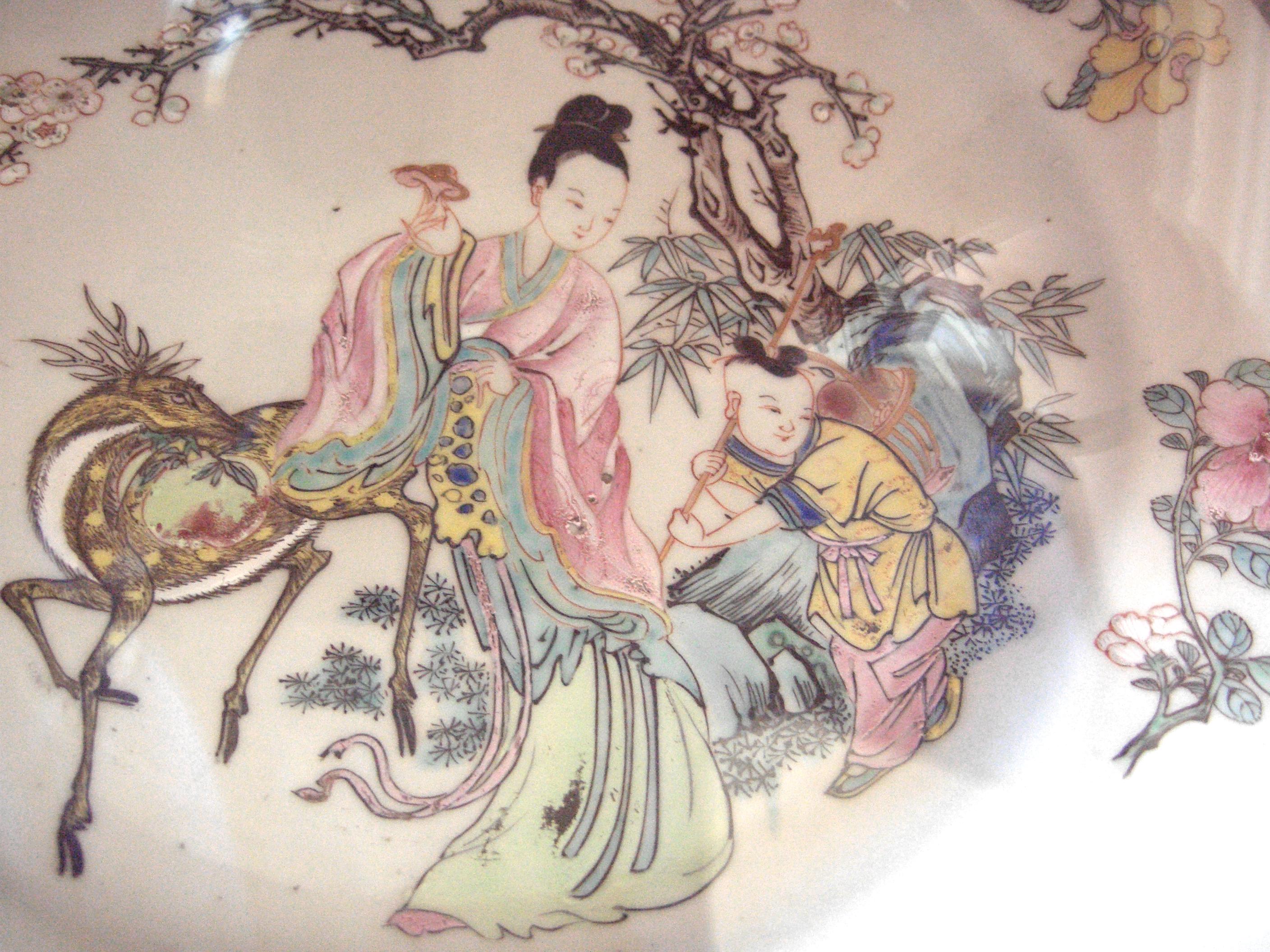
The Queen Mother of the West (西王母) is an ancient Chinese goddess whose origin can be traced back to oracle bone inscriptions of the fifteenth century BCE that record sacrifices to a "western mother". (Cahill, 1993) Even though these inscriptions illustrate that she predates organized Taoism, she is most often associated with Taoism. From her name alone some of her most important characteristics are revealed: she is royal, female and is associated with the west. (Benard, 2000) .

The growing popularity of the Queen Mother of the West, as well as the beliefs that she was the dispenser of prosperity, longevity, and eternal bliss took place during the second century BCE when the northern and western parts of China were able to be better known because of the opening of the Silk Routes. (Mair, 2006)

Her official Taoist title is Yaochi Jinmu (瑤池金母), or the Golden Mother of the Shining Lake. Historical (T'ang dynasty) biographers name her:


  • Chin mu yüan chün, The Primordial Ruler, Metal (Gold) Mother; 
  • Metal (Gold) Mother of Tortoise Mountain, She of the Nine Numina and the Grand Marvel; and
  • The Perfected Marvel of the Western Florescence and the Ultimate Worthy of the Grotto Yin. 

Commoners and poets of the T'ang dynasty referred to her more simply as Queen Mother; Divine Mother; or by the ancient, familiar expression for "mother" or "nanny", Amah.

Much more at...
Xi Wangmu, the shamanic great goddess of China
by Max Dashu

Thursday, January 22, 2009

The French Connections...

Today's news reports claim that China is ready to make amends with France over their pre-Olympic, anti-China stance on Tibet.
China ready to mend ties with France: govtAFP - 58 minutes ago
BEIJING (AFP) - China said Thursday it was ready to mend ties with France following a deep row over Tibet, in its first conciliatory move since tensions flared last year.
China Premier Wen's Europe Trip To Focus On Econ Cooperation Wall Street Journal
China says Wen offers Europe "journey of confidence"
While the headlines mention this as the "first conciliatory move," it seems they might have overlooked what has been going on in Harbin for the past several months. Each year one of the coldest regions of China celebrates its notoriety by immersing itself in the beauty and magic of the ice and cold season in a tradition that dates back more than a thousand years.

This year the theme is France... and it had to be planned somewhat in advance. Clever these Chinese, in so many ways. The Harbin Ice Festival was officially proclaimed in 1985 following the Cultural Revolution in China, but dates back to ancient times when villagers would partially freeze a bucket of water, remove the outer shell, put a candle inside and make an ice lantern. Be sure to click that link above to see a bunch of amazing photos and some videos depicting what an incredible event this has become.

Saturday, December 20, 2008

China's first mass-produced hybrid electric car hits the market 2008 | BYD Auto, Chinese company backed by Warren Buffett

A Car in Every Port
BYD Auto: China's first mass-produced hybrid car goes on sale

BEIJING, Dec. 15, 2008 (AFP) -- China's first mass-produced hybrid electric car hit the market on Monday, its manufacturer said, in a move aimed at driving the nation to the cutting edge of the world's green auto industry.

The car is made by BYD Auto, a Chinese company backed by American Warren Buffett, one of the world's most successful investors who owns 9.9 percent of the firm.


The F3DM is also the world's first mass-produced plug-in hybrid car, meaning owners can charge it from powerpoints at home for the first time, as well as in specialised electric car charging stations, according to BYD.

BYD president Wang Chuanfu was quoted by Chinese media as saying that his firm and China were on their way to being world leaders in the fuel-efficient auto industry.

"Through the F3DM dual-mode electric vehicle, BYD will grab a head-start in the new energy automobile market," he said at the launch in the southern city of Shenzhen, according to Auto 18, an online platform for China's auto industry.

A spokeswoman for the company confirmed the launch took place on Monday, but gave no other details.

BYD, which also specialises in making rechargeable batteries, only started making cars in 2003 when it bought a bankrupt state-owned auto company.

Its hybrid car is planned to first go on the market in 14 Chinese cities, and the firm is initially focusing on striking deals for company fleets rather than individuals, mycar168.com, another auto website, quoted Wang as saying.

The United States, meanwhile, is currently examining the F3DM to see if it meets the necessary standards for its domestic market, a spokesperson for the firm was quoted as saying by pcauto.com.cn, another car-focused web portal.

Exports to the United States could begin from 2010, according to the report.

The Prius hybrid electric car, made by Japan's Toyota, is currently sold in China, but the F3DM is the first locally made hybrid vehicle to hit the market.

Other carmakers in China have also manufactured these types of hybrid cars but never released them for public sale, said Duan Chengwu, a Shanghai-based technical analyst with international market research firm Global Insight.

The F3DM, meanwhile, has beaten Toyota and General Motors in the plug-in area, as the two companies only plan to launch hybrid cars that can be charged from home in 2009 and 2010 respectively, Duan said.

BYD's hybrid car, which can run 100 kilometres (62 miles) on a full battery, will cost just under 150,000 yuan (22,000 dollars).

Duan expressed doubt that the F3DM would initially be successful with Chinese customers because of the high price.

"In the initial stage, I don't think Chinese customers will buy a lot of these cars, but BYD wants to use them to test the waters," he said.

"Ultimately, though, this kind of car has a big potential in the Chinese market, and in the world market, because we all know we need new energy cars to solve the environmental and oil crisis problems."

Duan said Chinese automakers still lagged behind Western companies in conventional car technologies, but were at a similar level when it came to hybrids.

"The Chinese manufacturers have the opportunity to leapfrog the traditional technologies and to gain a leading position in terms of new energy cars," he said.

Copyright 2008 -- Agence France-Presse

Saturday, December 6, 2008

Discovering Yi-Fu Tuan

While teaching as a professor at the University of Minnesota in 1968 Yi-Fu Tuan began developing and espousing his philosophy of systematic humanistic geography. Of the two branches of systematic geography (physical and human) that exist, human geography employs many of the techniques used in the humanities such as source analysis and the use of text and literature to make findings.

Here's the abstract from an article Yi-Fu Tuan published in The Annals of the Association of American Geographers, February 2005 edition that explains it best:
The focus of humanistic geography is on people and their condition. Humanistic geography is thus not primarily an earth science, yet it is a branch of geography because it reflects upon kinds of evidence that interest other branches of the discipline. The following topics are briefly noted from the humanistic perspective: geographical knowledge, territory and place, crowding and privacy, livelihood and economics, and religion. The basic approach to these topics is by way of human experience, awareness, and knowledge. Humanistic geography contributes to science by drawing attention to facts hitherto beyond the scientific purview. It differs from historical geography in emphasizing that people create their own historical myths. A humanist geographer should have training in systematic thought, or philosophy. His work serves society essentially by raising its level of consciousness.
Tuan was born in 1930 in Tientsin, China. He studied at Oxford and earned a Phd at Berkeley. After fourteen years teaching at the University of Minnesota, he then moved to Madison, Wisconsin, citing the impending doom of a mid-life crisis that turned out to be mild. Tuan concluded his professional career at University of Wisconsin-Madison, in 1998.

Today Yi-Fu Tuan is a retired professor-emeritus of the University of Wisconsin, Madison. He gives many lectures and has recently published a book entitled Place, Art and Self.

Space and Place: The Perspective of Experience, published by Tuan more than 25 years ago, established the discipline of human geography, but it has proven influential in such diverse fields as theatre, literature, anthropology, psychology, and theology. Yi-Fu Tuan considers the ways in which people feel and think about space, how they form attachments to home, neighborhood, and nation, and how feelings about space and place are affected by the sense of time. He suggests that place is security and space is freedom: we are attached to the one and long for the other. Whether he is considering sacred versus "biased" space, mythical space and place, time in experiential space, or cultural attachments to space, Tuan's analysis is thoughtful and insightful throughout.

He currently resides in Wisconsin. Here's a great story about the young Yi-Fu... Lost in Place; Yi-Fu Tuan may be the most influential scholar you've never heard of.

Thursday, November 27, 2008

Saving a lost art... Chinese Street Food

During the Maoist years street chefs were banned from providing their distinctive cuisine. Despite the invasion of McDonald's and KFC there are some people who are working to revive the diversity of foods and cooking styles provided in Chinese street food. Some of these vendors trace their lineage in the culinary arts back over 200 years and through 7 generations. 

Wednesday, November 5, 2008

Verite to Host 10th Symposium on Social Responsibility in China

Verite', a 2007 Skoll award recipient, is hosting its 10th annual symposium on Social Responsibility in China on November 19 - 20, 2008 in Dongguan, China. This year's symposium will explore current trends and innovations in social responsibility programming in China. Over one and a half days are devoted to hearing from leaders in the field who are charting new approaches to solving common social compliance problems. The format will be in interactive, facilitating sharing and learning among participants.

Topics will include:
  • The role of civil society and workers in supporting sustainable change in working conditions in China
  • The new Contract Labor Law, its application and impact on the workplace
  • Worker engagement and other best practices for long-term sustainability in sourcing
  • Transparency as the starting place for change
Sponsors include Macy's, New Balance Foundation and Target. Read about last year's symposium for a glimpse of what they accomplished in 2007.

Friday, October 10, 2008

The Virtual Gugong

The Forbidden City: Beyond Space and Time is a new Web site created under a partnership between The Palace Museum and IBM. The site provides visitors with access to an immersive 3-dimensional virtual world where you can celebrate and explore aspects of Chinese culture and history.

In late 2006 I visited the Forbidden City with my friend Yang Pei. We spent the day hiking deeper and deeper into the core, touring scores of niche museums that archived various time frames along the path of Chinese history. It was both physically and intellectually overwhelming.

The virtual Gugong site encompasses the latest Web 2.0 dynamics, encouraging visitors to join in the site community in order to share in discussion and gain access to a greater number of features. I am downloading the 204MB application that will permit me to enter the virtual world. A half hour later I am installing the application. And, click to run... little wheel turns and turns, nothing happens. Stay tuned... there must be an answer.

Thursday, October 2, 2008

Return to a bicycling Beijing...

Today the Washington Post reported, "The government began taking 30 percent of its cars in the capital off the roads Wednesday in an attempt to make permanent some of the traffic restrictions imposed during the Olympic Games, officials and media reports said."

This brings to mind black and white photos I saw of Beijing streets "clogged" with bicycles, and very few cars. Yes, the days of chairman Mao have their bright spots.

WAPO says, "Beginning Oct. 11, Chinese motorists will also stop driving one workday a week, based on the final number on their license plates. In addition to the recent traffic changes, businesses will begin staggering their hours, with large department stores opening at 10 a.m. and other offices beginning work between 8:30 and 9:30 a.m.."

There are many ways to apply these examples of Chinese "green thinking" that western cities might consider adopting, as we all work to lower carbon emissions.

Saturday, September 6, 2008

The China connection(s)

Thomas Crampton is one of my many China connections...

Crampton writes about Obama’s Sun Yat Sen Connection, revealing that Obama and "the father of modern China, attended the same prep school in Hawaii" - even though they were students at Punaho School almost a hundred years apart. Most Americans probably wonder why any of this is important.

A hundred years in a culture over 7,000 years old is, much less significant than it might appear to be in a culture that is slightly more than 200 years old. The Chinese know and respect Sun Yat Sen - very much like Americans know and respect George Washington - because like Washington, Sun Yat Sen led a revolt against the monarchy, toppling the last emperor to rule China under the Qing Dynasty in 1911.

Did you know Sun Yat Sen was also an American citizen?

One of his most famous works is a publication known as the Three Principles of the People - including the principle of nationalism (minzu, 民族), democracy (minquan, 民權) and the People's Livelihood (minsheng, 民生).

TC says, there's other Obama China connection: that Obama's half-brother runs a dotcom out of Shenzhen and is married to a Chinese woman.

Wednesday, August 20, 2008

Mao Zedong, Madame Mao and Hua Guofeng

One of the first things I realized when I arrived in Beijing in November of 2006 was that my historical knowledge of a country that traces its own origins back for more than 4,000 years, was simply missing. After spending a day walking through the Forbidden City with my friend Yang Pei, I quickly came to realize that the mountain I originally perceived was merely the tip of a gigantic iceberg, submerged with more than 9/10ths invisible to my western eyes.

I went back to my hutong and started building a graphic animation, a timeline that I could use to visually take me from the here-and-now, back through the dynasties to the beginnings of recorded time. Today, the announcement of the death of China's Hua Guofeng reminds me that I still have lots of Asian history homework to do. Digging through the Wikipedia like an archeologist... I assemble another detailed segment in my timeline of transition.

Born to a poor family of Shanxi province in 1921, Hua Guofeng was originally named Su Zhu (蘇鑄). In 1936, at the age of 15, he joined the Long March. Like many young revolutionaries in those times, he took on a long and patriotic name: Zhonghua kangri jiuguo xianfengdui (中華抗日救國先鋒隊), which means "Chinese, Resisting-the-Japanese, Nation-saving, Vanguard. Later he shortened it to Hua Guofeng. In 1938 he joined the Communist Party of China and in 1969 and was named to the Central Committee, where he eventually succeeded Zhou Enlai as prime minister. On his deathbed in 1976, Mao Zedong selected Hua Guofeng as his successor.

During a relatively short term of leadership, Hua is credited for quickly ousting the Gang of Four, a group led by Mao's widow - his last wife of 38 years - Jiang Qing and her three close associates, Zhang Chunqiao, Wang Hongwen and Yao Wenyuan. The Gang of Four effectively controlled the power organs of the Communist Party of China through the latter stages of the Cultural Revolution, although it remains unclear which major decisions were made through Mao Zedong and carried out by the Gang, and which were the result of the Gang of Four's own planning. Jiang Qing's explanation is remembered as her most familiar quote: "I was Chairman Mao's dog. When Chairman Mao asked me to bite, I bit!"

Near the end of Mao's life, a power struggle occurred between the Gang of Four and the alliance of Deng Xiaoping, Zhou Enlai, and Ye Jianying. The "Gang" hoped that key military leaders, Wang Dongxing and Chen Xilian would support them, but it seems that Hua won the Army over to his side. Their downfall in a coup d'état on October 6, 1976, merely a month after Mao's death, brought about major celebrations on the streets of Beijing, and marked the end of a turbulent political era in China.

The Gang of Four, along with disgraced Communist general Lin Biao, were labeled as the two major "counter-revolutionary forces" of the Cultural Revolution, and officially blamed for the worst excesses of the societal chaos that ensued during the ten years of turmoil from 1966-76.

Hua Guofeng became the leader whose emergence marked the end of the Cultural Revolution. However, Deng Xiaoping was already maneuvering to replace him. Hua was effectively stripped of his powers by 1978 and formally lost the chairmanship in 1981. Hua Guofeng, died today in Beijing at the age of 87.

Tuesday, August 19, 2008

East meets West... on the sands of time

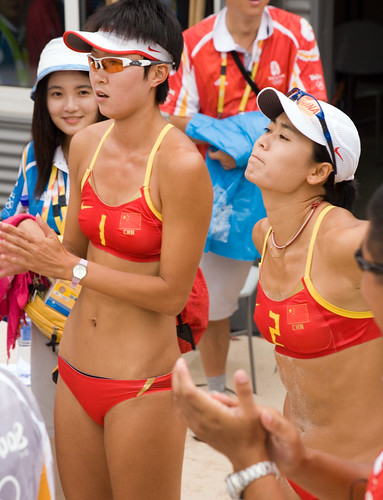
Wang Jie and Tian Jia outperformed their Chinese teammates, Xue Chen and Zhang Xi to represent China in the finals of women's beach volleyball on Thursday. They will face the American defending champions, Kerri Walsh and Misty May-Treanor - who remain unbeaten for more than a year.

May-Treanor says they won't allow the mass of patriotic Chinese fans to disrupt their concentration... "We'll just focus on the match, we will not be disturbed by the audience."

There are several things that come to mind all at once as I ponder this situation. I will try to focus, despite the discovery that not only are the Chinese using ancient, mystical and occult powers to sweep up the gold, but they are using western methods of mind control to do so.

Here's the inside story. It appears that the clever Chinese have discovered how to adapt the most ancient of Daoist philosophies, that of the Vulcan mind-meld, to unify and motivate an entire nation of supportive fans to bond with and thus empower, all of their Chinese Olympic competitors to the level of super-heroes.

This didn't come easily, however. Certain long-held traditions were casually sacrificed in order to employ these proven western tactics as a complement to the existing hive-mind tactics of Daoist harmony. Informed sources reveal that Chinese girls were selected for their physical features including "having great smiles and thin legs." Then it appears that they were forced to get suntans and placed into gangs where traditional taiji movement and Tibetan chanting was merged with other western influences to create the ultimate weapon of mass distraction: the Chinese women's beach volleyball Cheerleaders!


I cannot wait to get back to Beijing... to work for their liberation. These girls naturally provide lots of cheeky support as the British might say. See the scandalous evidence provided in agent BSR-12's photo report "Beijing - Day 6 (8/17)," somehow smuggled past China's strict media censors.

Wednesday, August 13, 2008

Lang Lang

Lang Lang just turned 26. He's an amazing classical pianist and kind of a nut. What kind of nut? You decide...

According to Wikipedia, "Lang Lang was two years old when he saw Tom playing piano in "The Cat Concerto," a Tom and Jerry cartoon on TV (Hungarian Rhapsody No. 2 in C-sharp minor composed by Franz Liszt). According to Lang Lang, this first contact with Western music was what motivated him to learn the piano."

He is both loved and hated, with some critics calling him "Bang Bang." No matter, he is an exciting and captivating artist, one that breaks the rules and has fun. I love Lang Lang!

Sunday, August 10, 2008

Dr. Ho Feng Shan, honored as a Righteous Gentile

Dr. Ho Feng Shan served as the Chinese Consul-General in Vienna in 1938-39. He was honored as a "Righteous Gentile" whose efforts saved thousands of Jews during the Holocaust. Boys Town Jerusalem, embodied the concept of Hakarat Hatov - acknowledgment and gratefulness - in adding a memorial for Dr. Ho to their commemorative garden in Jerusalem in 2004.

"He used his position to provide visas for Austrian Jews fleeing the Nazis - one of the first diplomats to do so," they explain. "The title of 'Righteous Among the Nations' was bestowed upon him in October, 2000 for his humanitarian courage in issuing Chinese visas to Jews. Nazi policy at the time was not to deport Jews who could show they had visas to foreign countries, and Dr. Ho, disregarding instructions from his superior, the Chinese Ambassador in Berlin, issued visas to Shanghai to all who Jews requesting them. At the time, the Viennese consulates of England, France, Switzerland and others refused to do so."

The Shanghaiist.com has an article and a video interview with Israeli photojournalist and documentary film maker Dvir Bar-Gal all about Shanghai's Jewish history and the story of Dr. Ho Feng Shan who died in San Francisco in 1997 at the age of 96.

Friday, August 8, 2008

Olympics links... Happy 8-08-008

Wired Magazine says, "The 2008 Beijing Olympics will happen while most Americans are sleeping. While NBC, the games' official media outlet in the United States, will be providing thousands of hours of content on the web, the only way to truly ensure you won't miss too many record-breaking moments is to spread yourself across the web and take advantage of the many video outlets online." So, they launched a Wiki article: Watch the Olympics Online.

The Summer Games Channel on YouTube will provide a burgeoning collection of professional video content produced by the Associated Press, The New York Times, Getty Images, Reuters, France 24, The Travel Channel, GroundReport, Euronews, and Paralympic Sport TV. The Summer Games channel has the official backing of some of the top sources around.

Here's another collection of 25 Sites to Experience the Beijing Summer Olympics.

SUMM3R provides a place for posting and finding news, photos and videos from the Summer Olympics in China. Create a profile to track your reading history and comments throughout the games. Want to follow a particular athlete, sport or country?.

This official screensaver from the International Olympic Committee celebrates the 2008 Olympic Games in Beijing. The screensaver offers a variety of photos showcasing the people and culture of Beijing, China. It also includes a persistent RSS feed of IOC Olympic-focused news.

Monday, August 4, 2008

What's in my China bag?

Last week I stumbled upon the writings of Derrick Story, a reporter assigned to Beijing, who wants to remain light, mobile and yet well-equipped. He shares the details of his collection of must-have electronic gadgetry in Assignment Olympics: What's in the Bag. Combing through his narrative after just taking a (very short) walk in the Wisconsin woods about an hour before sunrise, reminds of what is missing from his list.

I am walking down a fresh cut, made into the forest by a road-making crew. It is absolutely dark and I discover a large, unexpected rock in the middle of what I expected to be a smooth bulldozer-graded pathway. I immediately remember my winter in China and slow down, heighten my senses and begin to choose each step with conscious intent and focus. Pay attention! A few more steps and I discover an ankle-breaking hole, but because I am alert and moving much like a person without sight, I sense the hole with my foot and avoid stepping into it.

This is how you learn to walk in China. Assume that nothing is safe when it comes to sidewalks, stairs, streets and pathways. You will soon learn to take each step with a heightened sense of awareness... or accidents may happen.

In Shanghai I was delighted to see so many people riding silent, electric, two-wheeled scooters. At night, the frugal Chinese save battery power by turning off their headlights as they whisk down the narrow crowded streets at more than 25kph. You quickly learn to pay attention to each and every step you take. There are occasional holes in the sidewalks and pipes sticking out here and there.

In Dali, a small and ancient city where I lived at the base of a range of mountains, there are streams that run alongside most of the streets, downhill from west to east. There are no fences or guard railings to keep you from stepping off the edge, falling 1 - 4 feet into the gurgling waters. That would make it harder for people to wash their clothes or vegetables.
China has been working at a blistering pace to prepare Beijing for an influx of foreigners. Many of the old public toilets in the hutongs of the city have been torn down and replaced with new modern facilities. Within a few months all of the prostitutes on my street disappeared, the pirate music shops put away their catalogs of bootleg CDs and the street vendors, selling the latest Hollywood blockbuster DVDs for less than a buck, are gone.

I still wonder how many foreigners, coming from the "developed" world, where fear of law suits insures a high level of attention paid to public safety, will discover how much they take for granted. What's in my China bag? A wind-up powered, LED flashlight and a small, thin pocket knife are two of the things I never left home without.

The air in Beijing never bothered me but those who are concerned can now check the Daily Air Quality Monitoring Map. Richard Spencer explains the pollution tracking methods used to create the map.

Here's another useful set of maps for those seeking to comprehend the new building layout in Beijings Olympic center: BBC Sport's Olympic Map.

Sunday, July 27, 2008

Anyang City and the Oracle Bone Script

Anyang City in Hénán Province is known for its proximity to one of the oldest and largest historical sites in China with ruins that date back to the Shang Dynasty (16-11 centuries B.C.). Historically the site was known as Yinxu (Yin City), one of the seven ancient capitals. In 2006 the site was included in the UNESCO World Heritage List as one of the earliest centers of Chinese civilization.

The ruins, which span 24 square kilometers, are open to the public as the Garden Museum of Yinxu. Their antiquity was validated with the discovery of a large number of oracle bones inscribed with oracle bone script, the earliest recorded form of Chinese writing, traceable back to the Bronze Age.

The oracle bones, also known as Dragon bones were made of turtle shell, burned and inscribed in a process of divination known as pyromancy. Due to the fundamental importance of fire in society, it is quite likely that this was one of the earliest forms of divination.

The ritual of consulting the oracle bones included marking them with the date of the consultation using the Sexagenary Cycle, known as 10 Heavenly Stems and 12 Earthly Branches, a means of numbering days and years. This is the same system, still in use today, that designates 2008 the year of the Yang Earth Rat.

Wednesday, July 23, 2008

WTO "G-7" includes China

China gets seat at the World Trade Organization's top trade talks table

GENEVA — China took a seat for the first time in the World Trade Organization's most select negotiating group when seven commercial powers met Wednesday.

The meeting behind closed doors at the WTO's headquarters in Geneva aims to break a stalemate between rich and poor countries over liberalizing trade in agriculture and manufacturing.

China joined the United States, European Union, Brazil, India, Japan and Australia in a "G-7" meeting hosted by WTO chief Pascal Lamy.

"Of course it's important," Sun Zhenyu, China's WTO ambassador told The Associated Press as he made his way to the negotiating room. "We will do our best to help conclude the trade round."

The meeting comes a day after a contentious, seven-hour gathering of over 30 top negotiators ended with Lamy postponing a similar, large-group meeting scheduled for Wednesday.

Officials said the smaller group of seven powers - which account for most of global trade - would look for ways to advance this week's crucial talks on a new global trade pact by examining issues such as U.S. farm subsidy limits and industrial tariffs in emerging markets.

The so-called Doha free trade round has dragged on since its inception in Qatar's capital in 2001. Developing nations want agricultural tariffs and subsidies in rich countries to come down so they can sell more of their produce, while the U.S., 27-nation EU and others seek better conditions in emerging economies for their manufacturers, banks, insurers and telecommunications companies.

Beijing joined the WTO in 2001. Despite rapid trade growth in recent years, it has often taken a back seat in negotiations and allowed Brazil and India to assume leadership roles.

It has never met in such a select group of negotiators, even though its ability to export cheap goods has been a major - if often unspoken - factor in the refusal of allies such as Brazil and India to open up their industrial markets.

The United States made the first significant concession of the week on Tuesday, slicing US$1.4 billion from any previous offer to limit contentious, trade-distorting subsidies to American farmers.

U.S. Trade Representative Susan Schwab told a news conference that Washington was prepared to rewrite elements of its recently passed farm bill to ensure that U.S. subsidies deemed to unfairly enhance the competitiveness of American farmers are limited to $15 billion annually.

While Congress may view the move skeptically, the move shifted pressure to Brazil, India and other emerging economies to come up with a commensurate move. They refused, arguing the U.S. offer did not cut subsidies enough.

"I hope this is not the last offer," said Foreign Minister Celso Amorim of Brazil, which along with India leads a broad coalition of developing countries. "It's a very low level of ambition."

Emerging countries have demanded a subsidy cap closer to $12 billion for the United States, noting that U.S. subsidies have fallen to around $9 billion annually amid higher prices for basic commodities.

The poorer countries charge the payments with providing rich-world farmers an unfair competitive advantage that hinders Third World development. But the Bush administration - and the U.S. Congress - have sought flexibility in case crop prices fall and American farmers need greater support.

Congress recently overrode President Bush's veto to pass a new, five-year farm bill worth $300 billion that maintains and in some cases extends subsidies for American farmers. It could also derail any global trade deal by picking it apart line-by-line, as Bush has lost the power to send Congress a deal for simple yes or no vote.

Negotiators are hoping for agreement this week on a deal that would liberalize world agriculture and manufacturing, setting the stage for an overall trade accord by the end of the year. After years of negotiations and missed deadlines, there is widespread skepticism.
Monday, July 7, 2008

China issues 8 Yuan Note!

Scrapbookin'...
The following stuff just needs to get pasted into my China scrapbook. Six million of these new 10 yuan banknotes are being released to commemorate the Beijing Olympics. I wonder if there was any discussion about the possibility of issuing a special 8 yuan note in harmony with the 8:08pm opening of the games on 8/8/2008. The note features the Beijing National Stadium, known as the "Bird's Nest."


Some of the many famous Chinese actors who came together to create this earthquake victim tribute include: Jacky Cheung, Karen Mok, Andy Hui, Shirley Kwan and Wong Ka Keung.

Thursday, July 3, 2008

Mainstream Media blogs on China...

As is typically the way with the Internet, one thing leads to another. It was this headline in Google News that led to a number of other discoveries:
Best of the China Blogs: July 4
Wall Street Journal Blogs - 2 hours ago
But in China, there are only about 15000 players. This post considers some of the cross-cultural implications of the “alternate reality game” in China. [Virtual China] –Freedom of information has been a hot topic among the Chinese media since a new law ...
Perhaps it's time to pay more attention to the mainstream, despite the churnalism. The WSJ and Newsweek have both created specific China blogs so, now I am on a mission to find the rest and continue to update this post as I find the links and resources.
China Journal tracks the changes taking place in the world's most populous country, drawing on the insights of the Journal's award-winning team of nearly 20 journalists covering China to explain developments in the country's business world, economy, and culture. Sky Canaves is the lead writer for China Journal. You can write to the blog authors at chinajournal@wsj.com.
Newsweek's China blog, Countdown to Beijing is currently dedicated to the Olympics, but hopefully it will continue afterward with a new focus. They feature some outstanding journalists like Melinda Liu, and spice up their articles with hypertext - like I said, one thing leads to another.

Friday, June 27, 2008

China's State-run Telecom and Banking News...

Great iPhone Wall of China crumbling, could tumble this year says Chris Foresman at Ars Technica. "According to statements from China Mobile executives today, talks are again on with Apple to bring the iPhone to China.

Reuters confirms: China Mobile says iPhone talks scale biggest hurdle

In China We Trust
Posted by Rick Carew –With Victoria Ruan
Foreign banks are scouring China for opportunities to break into the trust industry. The latest: Royal Bank of Scotland (RBS). RBS received approval Friday from China’s banking regulator to buy 20% in eastern China’s Suzhou Trust, a person familiar with the situation tells Dow Jones Newswires.

The bank already holds a stake in one of China’s four biggest banks, Bank of China, so why mess with a little trust company in Suzhou? (Besides the famed beauty of Suzhou’s gardens). Buying into a Chinese trust company offers two potential paths to profits: wealth management and private equity.

Trust companies in China are allowed to buy stakes in companies that are mostly off-limits to commercial banks or securities firms. The trust firm then repackages those assets into products that it can sell to wealthy individuals. That’s the wealth management bit.

People in the industry are expecting that government regulators will also eventually allow trust companies to keep those investments on their books, allowing them to act similarly to private equity firms. It’s still too early to tell which of the two types of business will come to dominate the industry as a government push to consolidate and weed out smaller players is under way.