Showing posts with label China. Show all posts

Saturday, December 20, 2008

China's first mass-produced hybrid electric car hits the market 2008 | BYD Auto, Chinese company backed by Warren Buffett

A Car in Every Port
BYD Auto: China's first mass-produced hybrid car goes on sale

BEIJING, Dec. 15, 2008 (AFP) -- China's first mass-produced hybrid electric car hit the market on Monday, its manufacturer said, in a move aimed at driving the nation to the cutting edge of the world's green auto industry.

The car is made by BYD Auto, a Chinese company backed by American Warren Buffett, one of the world's most successful investors who owns 9.9 percent of the firm.


The F3DM is also the world's first mass-produced plug-in hybrid car, meaning owners can charge it from powerpoints at home for the first time, as well as in specialised electric car charging stations, according to BYD.

BYD president Wang Chuanfu was quoted by Chinese media as saying that his firm and China were on their way to being world leaders in the fuel-efficient auto industry.

"Through the F3DM dual-mode electric vehicle, BYD will grab a head-start in the new energy automobile market," he said at the launch in the southern city of Shenzhen, according to Auto 18, an online platform for China's auto industry.

A spokeswoman for the company confirmed the launch took place on Monday, but gave no other details.

BYD, which also specialises in making rechargeable batteries, only started making cars in 2003 when it bought a bankrupt state-owned auto company.

Its hybrid car is planned to first go on the market in 14 Chinese cities, and the firm is initially focusing on striking deals for company fleets rather than individuals, mycar168.com, another auto website, quoted Wang as saying.

The United States, meanwhile, is currently examining the F3DM to see if it meets the necessary standards for its domestic market, a spokesperson for the firm was quoted as saying by pcauto.com.cn, another car-focused web portal.

Exports to the United States could begin from 2010, according to the report.

The Prius hybrid electric car, made by Japan's Toyota, is currently sold in China, but the F3DM is the first locally made hybrid vehicle to hit the market.

Other carmakers in China have also manufactured these types of hybrid cars but never released them for public sale, said Duan Chengwu, a Shanghai-based technical analyst with international market research firm Global Insight.

The F3DM, meanwhile, has beaten Toyota and General Motors in the plug-in area, as the two companies only plan to launch hybrid cars that can be charged from home in 2009 and 2010 respectively, Duan said.

BYD's hybrid car, which can run 100 kilometres (62 miles) on a full battery, will cost just under 150,000 yuan (22,000 dollars).

Duan expressed doubt that the F3DM would initially be successful with Chinese customers because of the high price.

"In the initial stage, I don't think Chinese customers will buy a lot of these cars, but BYD wants to use them to test the waters," he said.

"Ultimately, though, this kind of car has a big potential in the Chinese market, and in the world market, because we all know we need new energy cars to solve the environmental and oil crisis problems."

Duan said Chinese automakers still lagged behind Western companies in conventional car technologies, but were at a similar level when it came to hybrids.

"The Chinese manufacturers have the opportunity to leapfrog the traditional technologies and to gain a leading position in terms of new energy cars," he said.

Copyright 2008 -- Agence France-Presse

Friday, October 10, 2008

The Virtual Gugong

The Forbidden City: Beyond Space and Time is a new Web site created under a partnership between The Palace Museum and IBM. The site provides visitors with access to an immersive 3-dimensional virtual world where you can celebrate and explore aspects of Chinese culture and history.

In late 2006 I visited the Forbidden City with my friend Yang Pei. We spent the day hiking deeper and deeper into the core, touring scores of niche museums that archived various time frames along the path of Chinese history. It was both physically and intellectually overwhelming.

The virtual Gugong site encompasses the latest Web 2.0 dynamics, encouraging visitors to join in the site community in order to share in discussion and gain access to a greater number of features. I am downloading the 204MB application that will permit me to enter the virtual world. A half hour later I am installing the application. And, click to run... little wheel turns and turns, nothing happens. Stay tuned... there must be an answer.

Wednesday, August 20, 2008

Mao Zedong, Madame Mao and Hua Guofeng

One of the first things I realized when I arrived in Beijing in November of 2006 was that my historical knowledge of a country that traces its own origins back for more than 4,000 years, was simply missing. After spending a day walking through the Forbidden City with my friend Yang Pei, I quickly came to realize that the mountain I originally perceived was merely the tip of a gigantic iceberg, submerged with more than 9/10ths invisible to my western eyes.

I went back to my hutong and started building a graphic animation, a timeline that I could use to visually take me from the here-and-now, back through the dynasties to the beginnings of recorded time. Today, the announcement of the death of China's Hua Guofeng reminds me that I still have lots of Asian history homework to do. Digging through the Wikipedia like an archeologist... I assemble another detailed segment in my timeline of transition.

Born to a poor family of Shanxi province in 1921, Hua Guofeng was originally named Su Zhu (蘇鑄). In 1936, at the age of 15, he joined the Long March. Like many young revolutionaries in those times, he took on a long and patriotic name: Zhonghua kangri jiuguo xianfengdui (中華抗日救國先鋒隊), which means "Chinese, Resisting-the-Japanese, Nation-saving, Vanguard. Later he shortened it to Hua Guofeng. In 1938 he joined the Communist Party of China and in 1969 and was named to the Central Committee, where he eventually succeeded Zhou Enlai as prime minister. On his deathbed in 1976, Mao Zedong selected Hua Guofeng as his successor.

During a relatively short term of leadership, Hua is credited for quickly ousting the Gang of Four, a group led by Mao's widow - his last wife of 38 years - Jiang Qing and her three close associates, Zhang Chunqiao, Wang Hongwen and Yao Wenyuan. The Gang of Four effectively controlled the power organs of the Communist Party of China through the latter stages of the Cultural Revolution, although it remains unclear which major decisions were made through Mao Zedong and carried out by the Gang, and which were the result of the Gang of Four's own planning. Jiang Qing's explanation is remembered as her most familiar quote: "I was Chairman Mao's dog. When Chairman Mao asked me to bite, I bit!"

Near the end of Mao's life, a power struggle occurred between the Gang of Four and the alliance of Deng Xiaoping, Zhou Enlai, and Ye Jianying. The "Gang" hoped that key military leaders, Wang Dongxing and Chen Xilian would support them, but it seems that Hua won the Army over to his side. Their downfall in a coup d'état on October 6, 1976, merely a month after Mao's death, brought about major celebrations on the streets of Beijing, and marked the end of a turbulent political era in China.

The Gang of Four, along with disgraced Communist general Lin Biao, were labeled as the two major "counter-revolutionary forces" of the Cultural Revolution, and officially blamed for the worst excesses of the societal chaos that ensued during the ten years of turmoil from 1966-76.

Hua Guofeng became the leader whose emergence marked the end of the Cultural Revolution. However, Deng Xiaoping was already maneuvering to replace him. Hua was effectively stripped of his powers by 1978 and formally lost the chairmanship in 1981. Hua Guofeng, died today in Beijing at the age of 87.

Tuesday, August 19, 2008

East meets West... on the sands of time

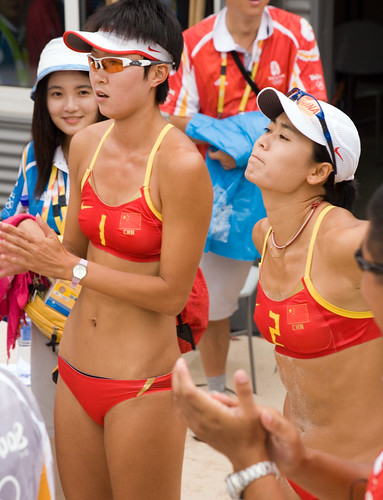
Wang Jie and Tian Jia outperformed their Chinese teammates, Xue Chen and Zhang Xi to represent China in the finals of women's beach volleyball on Thursday. They will face the American defending champions, Kerri Walsh and Misty May-Treanor - who remain unbeaten for more than a year.

May-Treanor says they won't allow the mass of patriotic Chinese fans to disrupt their concentration... "We'll just focus on the match, we will not be disturbed by the audience."

There are several things that come to mind all at once as I ponder this situation. I will try to focus, despite the discovery that not only are the Chinese using ancient, mystical and occult powers to sweep up the gold, but they are using western methods of mind control to do so.

Here's the inside story. It appears that the clever Chinese have discovered how to adapt the most ancient of Daoist philosophies, that of the Vulcan mind-meld, to unify and motivate an entire nation of supportive fans to bond with and thus empower, all of their Chinese Olympic competitors to the level of super-heroes.

This didn't come easily, however. Certain long-held traditions were casually sacrificed in order to employ these proven western tactics as a complement to the existing hive-mind tactics of Daoist harmony. Informed sources reveal that Chinese girls were selected for their physical features including "having great smiles and thin legs." Then it appears that they were forced to get suntans and placed into gangs where traditional taiji movement and Tibetan chanting was merged with other western influences to create the ultimate weapon of mass distraction: the Chinese women's beach volleyball Cheerleaders!


I cannot wait to get back to Beijing... to work for their liberation. These girls naturally provide lots of cheeky support as the British might say. See the scandalous evidence provided in agent BSR-12's photo report "Beijing - Day 6 (8/17)," somehow smuggled past China's strict media censors.

Sunday, August 10, 2008

Dr. Ho Feng Shan, honored as a Righteous Gentile

Dr. Ho Feng Shan served as the Chinese Consul-General in Vienna in 1938-39. He was honored as a "Righteous Gentile" whose efforts saved thousands of Jews during the Holocaust. Boys Town Jerusalem, embodied the concept of Hakarat Hatov - acknowledgment and gratefulness - in adding a memorial for Dr. Ho to their commemorative garden in Jerusalem in 2004.

"He used his position to provide visas for Austrian Jews fleeing the Nazis - one of the first diplomats to do so," they explain. "The title of 'Righteous Among the Nations' was bestowed upon him in October, 2000 for his humanitarian courage in issuing Chinese visas to Jews. Nazi policy at the time was not to deport Jews who could show they had visas to foreign countries, and Dr. Ho, disregarding instructions from his superior, the Chinese Ambassador in Berlin, issued visas to Shanghai to all who Jews requesting them. At the time, the Viennese consulates of England, France, Switzerland and others refused to do so."

The Shanghaiist.com has an article and a video interview with Israeli photojournalist and documentary film maker Dvir Bar-Gal all about Shanghai's Jewish history and the story of Dr. Ho Feng Shan who died in San Francisco in 1997 at the age of 96.

Friday, August 8, 2008

Olympics links... Happy 8-08-008

Wired Magazine says, "The 2008 Beijing Olympics will happen while most Americans are sleeping. While NBC, the games' official media outlet in the United States, will be providing thousands of hours of content on the web, the only way to truly ensure you won't miss too many record-breaking moments is to spread yourself across the web and take advantage of the many video outlets online." So, they launched a Wiki article: Watch the Olympics Online.

The Summer Games Channel on YouTube will provide a burgeoning collection of professional video content produced by the Associated Press, The New York Times, Getty Images, Reuters, France 24, The Travel Channel, GroundReport, Euronews, and Paralympic Sport TV. The Summer Games channel has the official backing of some of the top sources around.

Here's another collection of 25 Sites to Experience the Beijing Summer Olympics.

SUMM3R provides a place for posting and finding news, photos and videos from the Summer Olympics in China. Create a profile to track your reading history and comments throughout the games. Want to follow a particular athlete, sport or country?.

This official screensaver from the International Olympic Committee celebrates the 2008 Olympic Games in Beijing. The screensaver offers a variety of photos showcasing the people and culture of Beijing, China. It also includes a persistent RSS feed of IOC Olympic-focused news.

Sunday, July 27, 2008

Anyang City and the Oracle Bone Script

Anyang City in Hénán Province is known for its proximity to one of the oldest and largest historical sites in China with ruins that date back to the Shang Dynasty (16-11 centuries B.C.). Historically the site was known as Yinxu (Yin City), one of the seven ancient capitals. In 2006 the site was included in the UNESCO World Heritage List as one of the earliest centers of Chinese civilization.

The ruins, which span 24 square kilometers, are open to the public as the Garden Museum of Yinxu. Their antiquity was validated with the discovery of a large number of oracle bones inscribed with oracle bone script, the earliest recorded form of Chinese writing, traceable back to the Bronze Age.

The oracle bones, also known as Dragon bones were made of turtle shell, burned and inscribed in a process of divination known as pyromancy. Due to the fundamental importance of fire in society, it is quite likely that this was one of the earliest forms of divination.

The ritual of consulting the oracle bones included marking them with the date of the consultation using the Sexagenary Cycle, known as 10 Heavenly Stems and 12 Earthly Branches, a means of numbering days and years. This is the same system, still in use today, that designates 2008 the year of the Yang Earth Rat.

Monday, July 7, 2008

China issues 8 Yuan Note!

Scrapbookin'...
The following stuff just needs to get pasted into my China scrapbook. Six million of these new 10 yuan banknotes are being released to commemorate the Beijing Olympics. I wonder if there was any discussion about the possibility of issuing a special 8 yuan note in harmony with the 8:08pm opening of the games on 8/8/2008. The note features the Beijing National Stadium, known as the "Bird's Nest."


Some of the many famous Chinese actors who came together to create this earthquake victim tribute include: Jacky Cheung, Karen Mok, Andy Hui, Shirley Kwan and Wong Ka Keung.

Friday, June 27, 2008

China's State-run Telecom and Banking News...

Great iPhone Wall of China crumbling, could tumble this year says Chris Foresman at Ars Technica. "According to statements from China Mobile executives today, talks are again on with Apple to bring the iPhone to China.

Reuters confirms: China Mobile says iPhone talks scale biggest hurdle

In China We Trust
Posted by Rick Carew –With Victoria Ruan
Foreign banks are scouring China for opportunities to break into the trust industry. The latest: Royal Bank of Scotland (RBS). RBS received approval Friday from China’s banking regulator to buy 20% in eastern China’s Suzhou Trust, a person familiar with the situation tells Dow Jones Newswires.

The bank already holds a stake in one of China’s four biggest banks, Bank of China, so why mess with a little trust company in Suzhou? (Besides the famed beauty of Suzhou’s gardens). Buying into a Chinese trust company offers two potential paths to profits: wealth management and private equity.

Trust companies in China are allowed to buy stakes in companies that are mostly off-limits to commercial banks or securities firms. The trust firm then repackages those assets into products that it can sell to wealthy individuals. That’s the wealth management bit.

People in the industry are expecting that government regulators will also eventually allow trust companies to keep those investments on their books, allowing them to act similarly to private equity firms. It’s still too early to tell which of the two types of business will come to dominate the industry as a government push to consolidate and weed out smaller players is under way.

Wednesday, June 25, 2008

Channel Asia Bloggers...


www.channelnewsasia.com, in English, and www.cnachinese.com and www.xin.sg, in Chinese, are premier sources of real time news, videos, information and entertainment features for Asian professionals and executives working, living and investing in Asia. Updated throughout the day, the websites provide a truly interactive experience.

Eight news staff bloggers highlight the service with that certain personal, off-the-cuff touch like that of Yee Fong: "Having spent five years in China has taught me the importance of xian li hou bing or to be polite first before you engage in a battle."

Tuesday, June 24, 2008

The 12th annual World Wealth Report...

China led the way in attracting net private capital inflows, taking in about 55 billion dollars in 2007. Assets held overall by the world's millionaires soared to 40.7 trillion dollars last year from 2006, with the average exceeding 4.0 million dollars for the first time.

"This year's report found that the number of high net worth individuals (with net assets, excluding primary residences, of at least 1.0 million dollars), and the amount of wealth they control, continued to increase in 2007, with the greatest wealth being created in the emerging markets of India, China and Brazil," says Robert McCann, president of Global Wealth Management at Merrill Lynch.

The number of millionaires jumped 22.7 percent in India last year, 20.3 percent in China and 19.1 percent in Brazil.

During last year, the Standard and Poor’s 500 Index of the largest US stocks rose 3.7%, the UK’s FTSE 100 Index gained 2.4% and the Morgan Stanley Capital International Emerging Markets Index climbed 37%.

Growth in the number of millionaires slowed to about 4% in the US and 2.1% in the UK. That was outpaced by an 8.7% rise in the Asia-Pacific region and 16% jump in West Asia. The International Monetary Fund predicts advanced economies this year will suffer their fastest price gains since 1995 and their weakest expansion in seven years.

415,000... the number of millionaires in China.

Saturday, June 21, 2008

8-8-2008 Superstitions East vs West

Looking at each other like two fish, swimming in separate bowls, each thinking that the other one looks a bit odd... "I read the news today oh boy." The first story describes the "superstitious" Chinese who are blogging and texting about the curse of the Fuwa mascots.

The 5 "good luck dolls" patterned after 4 of China's favorite animals (Jingjing, a panda, native to Sichuan; Yingying, a Tibetan antelope; Nini, a swallow that looks like a kite; Beibei, the fish-shaped Fuwa) and a fifth, Huanhuan, who represents the Olympic flame, have each been paired up with one of the recent string of deadly tragedies that befell the country.

Britain's Telegraph reporter, David Eimer in Beijing explains ...
For all its shiny new buildings and rampant modernisation, China remains a deeply superstitious country. Fortune tellers continue to thrive. And last year hundreds of thousands of couples rushed to have children in the year of the Golden Pig, thought to be an especially lucky year to be born in.


Here in the west we look upon such superstitious thinking as a sure sign of ignorance. A recent poll says that 55% of Americans, including Senator John McCain, take great pride in the fact that we are a nation founded on christian principles. The motto "In God we trust" has been continuously stamped on the penny since 1909 and on the dime since 1916. That's not superstitious. Neither is wearing a cross... Right?


The second news story is about an Ohio public schoolteacher who burned a cross on the arm of one of his students. John Freshwater, a fervent, christian, anti-gay, science teacher who feels compelled to teach creationism, keeps a bible on his classroom desk and occasionally puts the fiery brand of his god on someone else's skin. And he's still teaching while his school board decides what to do.

Perhaps Freshwater will find refuge in Florida where brother Jeb, "has engineered onto the November ballot two initiatives that would eliminate the state constitution’s strict church-state separation provisions, mandate funding of religion and water down language requiring a quality public school system."

Perhaps one day, as China becomes more prosperous, we will be saved by plane loads of Buddhists "on a mission from God" knocking on America's doors and handing out sutras in shopping centers. Until then I can't wait to get back to Beijing.

Sunday, June 8, 2008

On a spiritual note...

James C. Ogden spent 20 years in Batang, in eastern Tibet as a Christian missionary and photographer. You can see a collection of his salvaged photos taken from 1905 - 1925 at Blue Spark Fine Art. The narrative incorrectly describes photos of the destruction of Lamaseries "due to pre-1905 Chinese invasions." The destruction was actually at the hands of the British in 1904.

But the battle for who gets to write the history goes on:

The Thaindian News reports little hope for exiles to come to agreement with China...
Samdhong Rinpoche, prime minister (Kalon Tripa) of the Tibetan government-in-exile based in the Indian town of Dharamsala, told IANS here in an exclusive interview, “We have serious differences with China over two core issues - history (of Tibet) and the population. We are ready to acknowledge that Tibet is now part of China. But we will not say that it was historically part of China. That is what China wants the Dalai Lama to say. We will not do it, as it will legitimise their occupation of Tibet.”

The exiled Tibetan leadership also disputes China’s division of Tibetan territory into 11 parts. “We want all these parts to be united and that region to be given full autonomy,” he added.

The next round of talks between the envoys of Tibetan spiritual leader the Dalai Lama and Chinese leaders are to be held in the last week of June after a gap of one year.


China has agreed to commit 70 million dollars to an international fund for the preservation of culture in Tibet. The Louise Blouin Foundation, a global non-profit group which is part of the agreement says, the money will be used to refurbish and preserve cultural relics and monasteries in the Tibet autonomous region.

Beijing has also agreed to allow Tibet's spiritual leader the Dalai Lama and the Tibetan government in exile to participate and "provide oversight" in the cultural preservation projects.

The agreement to set up the fund was reached recently between the foundation, the Chinese People's Political Consultative Conference, a top political advisory group, and China's ministry of Culture.

The Malaysian Star e-paper reports (below) on a meeting of the spiritual minds in China led by the Most Venerable Master Chin Kung.

Walking with the monks

ART OF HEALING
By DR AMIR FARID ISAHAK

This week, we take a break from health matters to look at a study tour of China.

RECENTLY, I was invited to join a group of monks on a study tour of the different cultures and religions in China. We were led by the Most Venerable Master Chin Kung, the Honorary Adviser to the Cheng Ho Multi Culture Education Trust (CHMCET), which sponsored the trip. The aim was to promote religious harmony and world peace.

Apart from the six Buddhist monks, their assistants, and the organising committee members, advisers and staff, the entourage included leaders of the other major faiths in Malaysia (Islam, Christianity, Hinduism, Sikhism and Taoism).

I was invited as an interfaith leader. There were 35 of us, from Malaysia, Singapore, Australia, and China.

The Grand Bazaar marks the commercial centre of the very busy city of Urumqi, the capital of the Xinjiang Uygur Autonomous Region.

The programme was very tight and we went straight from the airport to the first event even before we could check-in the hotel or rest. We visited the Diaoyutai State Guest House, which is an ornate building used as a resort palace by ancient emperors. Thereafter, we were treated to a grand reception.

In Beijing, we visited and had dialogues with the Buddhist Association of China, the China Taoist Association and the Islamic Association of China.

We also visited the China State Bureau of Religious Affairs. There we were given a thorough briefing on the relationship between the government and the various religions.

The Malaysian religious leaders were given ample opportunity to ask questions and I was impressed by the openness of the bureau’s director in responding to our queries. They also hosted a dinner in our honour.

China is anxious to convince the world that she is now very tolerant of all religions, provided that there is no political activism, especially any hint of independence or secession, among the adherents.

This is particularly so in the light of the recent events in Tibet, and the sporadic reports of separatist movements in some of the Muslim-majority regions.

Adventure on the Silk Road

From Beijing, we flew to Urumqi, the capital of the Xinjiang Uygur Autonomous Region. Urumqi was one of the main trading cities on the ancient Silk Road, and remains a very busy trading centre today. Goods and people from the former Soviet republics, Eastern Europe, Mongolia and the rest of China converge here. It is also turning into an industrial city.

Here we visited the old Shanxi Mosque, famous for its unique Chinese architecture.

Another highlight was the International Grand Bazaar, which marks the commercial centre of this very busy city. We were guests of a local Muslim businessman who proudly showed us his collection of old handwritten copies of the Qur’an. We also visited the Xinjiang College for Qur’an Study.

The beauty and enigma of Urumqi and Xinjiang are familiar to those who have read the classic story Journey to the West.

Xinjiang is larger than Malaysia, but has fewer people. There are 47 “minority” ethnic groups, the largest of which are the Uygurs. The people were once Buddhists, as evidenced by the ruins of Baizikeli Cheonbuldong (Thousand Buddhas Grottos) and the ancient Buddhist city of Gaochang.

Now the majority are Muslims, something not surprising seeing its close proximity to Khorasan (central Asian Muslim countries, which include the former Soviet republics) and the transmigration of Muslims since the 7th century CE.

Both the Buddhist historical sites were near Turpan, another trading city on the Silk Road, about three hours by bus from Urumqi. The highway to Turpan traversed the arid, barren and windy Gobi Desert. It forms part of the vast Turpan Basin, which is surrounded by the snow-topped Tian Shan mountains. Here is a display of nature’s bizarre contrasts.

The flaming mountain

The Gobi Desert is searing hot. The worst is the region near the Flaming Mountain. The flaming red mountain and the red soil surrounding it give it its apt name.

The surface ground temperature can reach 80°C and the ambient temperature can reach 50°C. At the Gaochang ruins, we walked with the monks under the scorching sun with only our cowboy hats as protection. Some did apply sun-block, but most of us were unprepared for the heat. Thus many of us did not complete the tour of the ruins.

If not for the strong winds that help cool the body, one can get cooked to death if stranded in the desert at noontime, which was what scared me when our bus broke down.

Fortunately, the driver was able to fix it within half an hour, while we were busy taking snapshots of ourselves in the blazing sun. In any case, we could easily summon help because our mobile phone signals were full even in the middle of the desert!

Being so far from the sea, the Turpan Basin is the lowest, driest and hottest place in China. At night, the cold winds can freeze you. The changing seasons also bring exquisite beauty to the different terrains and regions of Xinjiang. Even the Flaming Mountain becomes calm and charming in winter.

Despite the predominance of arid land, Xinjiang is able to supply power and an abundance of fruits and agricultural products to the whole of China. Its Grape Valley produces many varieties of grapes, and its raisins are exported to far away lands.

The strong winds of the desert are being harnessed for electricity. The highway is flanked by thousands of giant modern windmills. Turpan now has the world’s largest wind-powered power generation station.

There is also a salt lake that we passed by that is big enough to supply the needs of the two billion Chinese for the next 50 years.

But what is most remarkable is how this desert-land has been turned into an oasis that supplies the world with among the best and most nutritious grapes and raisins.

The valley of grapes

The answer lies in an ingenious well and canal system established by its inhabitants more than 2,600 years ago, which makes it the third Wonder of Ancient China after the Great Wall and the Grand Canal.

The system involves digging over a thousand wells on the mountains slopes right down to the valley to tap the underground canals and rivers that are fed by the melting snow on the mountain tops.

The canals altogether are over 5,000km long!

In the olden days, the wells were dug using buckets and pulleys. Later, modern methods were used, and the same underground canal system sustains the people, the orchards and the grapevines until now.

It is this clean mountain water and the abundant sunlight that make the grapes thrive in Xinjiang. The pears and peaches are also plentiful and exceedingly sweet. Many varieties of nuts are also marketed in the bazaars and roadside, with almonds being the favourite.

We visited an Uygur family who had been well-diggers for many generations and had switched to growing grapes when modern methods made their skills obsolete.

Our host was an expert on grapes and raisins and gave us a lesson on the goodness of the different varieties of raisins. Some raisins are good for the heart, for the urinary system, for diabetics and so on. We were also shown how some unscrupulous traders actually put dangerous dyes and additives to make their raisins look good or appear like the expensive varieties.

The way of health

Back in Beijing on our way home, the farewell lunch was at a Buddhist-themed vegetarian restaurant. On its menu is this caption: “The True Way of Health is to boost the body’s energy in all its forms”.

I couldn’t agree more. I have been trying to educate the public about the various forms of energy that we thrive on, and hence influence our health, and qi or life force is just one of them.

Although this entire trip was about understanding the different cultures and religions, and forging peace and harmony among us, there is at least this wise quotation for me to share about health.

The way of peace

Since this was an interfaith study tour, during the long bus journeys, we took turns explaining about our respective religions to the others. When we got tired of religious talks, we switched to singing and jokes.

This trip was under the supervision and guidance of the Most Venerable Master Chin Kung, possibly the most successful interfaith peacemaker in this region. He is respected for his work in China, Taiwan, Malaysia, Singapore, Indonesia, Australia and many other countries. He has established the Pure Land College in Australia, and the Centre of Chinese Cultural Education in Lujiang, China.

Through his work, he has transformed many lives, and even entire communities. At 82 years of age, he is still working hard for religious harmony and world peace.

He is humble, soft-spoken and ever smiling. During this trip he carried his personal fold-out fan everywhere. On it is written the fundamental teachings of Islam. Yet he is among the most famous Buddhist monks in the world today. I truly respect his wisdom and open-mindedness.

Throughout the trip we were given five-star accommodation and first class meals and treatment. I must thank Tan Sri Lee Kim Yew, the President of CHMCET, for his generosity in making the trip possible, and Datuk Tan Chai Ho, Chief Adviser of our study tour, and his team, for making it a memorable and enriching experience.

Dr Amir Farid Isahak is a medical specialist who practises holistic, aesthetic and anti-ageing medicine. He is a qigong master and founder of SuperQigong. For further information, e-mail starhealth@thestar.com.my.

The views expressed are those of the writer and readers are advised to always consult expert advice before undertaking any changes to their lifestyles. The Star does not give any warranty on accuracy, completeness, functionality, usefulness or other assurances as to the content appearing in this column. The Star disclaims all responsibility for any losses, damage to property or personal injury suffered directly or indirectly from reliance on such information.

Wednesday, May 28, 2008

On China, Tibet, the Olympics and Hollywood Celebrities

"It's so much easier to suggest solutions when you don't know too much about the problem." - Malcolm Forbes

Sorry my well-meaning friends but, I have no sympathy for the Dalai Lama (DL). After reading The Wisdom of Forgiveness, a 2004 release by "His Holiness" and Victor Chan, I nominate the DL as a master of passive-agressivity. This book is peppered with blame, cloaked as forgiveness. Following his lead, I too am ready to forgive the DL, his monks and the aristocracy that ruled in Tibet before 1949.
  • I forgive you for dominating and suppressing the Chinese Tibetan people under a social order that was far more cruel and reactionary than serfdom in Europe in the Middle Ages.
  • I forgive you and your cadre for failing to provide the people of Tibet with any system of public schools or universities.
  • I forgive you for taking young boys away from their families to enlist them in your religious order. I am sure they were much better off living in cloistered seclusion with a bunch of men in orange robes.
  • I forgive you for being especially dismissive of the women and girls of Tibet who were considered second class citizens and had no opportunity for education.
  • I forgive you DL for living in Portola, a 1,000-room palace while your serfs struggled to fend off the weather in mud huts.
  • I forgive you and your monks for living like parasites, doing no work, and demanding tithes from the masses you ruled over in Tibet.
The DL pretends complete innocence in perpetrating the quite timely outbreak of global protests and violence aimed at shaming China in its moment of pride and glory in Beijing on 08-08-2008. You succeeded in destroying the possibility of spreading a pervasive sense of global unity with the Olympic Torch relay. But I forgive you.

We Americans who live in a glass house (Gitmo, torture, corporate war profiteering, domestic spying, corporate death squads and the criminal invasion of Iraq) have NO business throwing stones at ANY other nation. Whenever the western media reflects on Tibet, the only invasion they ever mention is 1949, when Mao reclaimed the region as part of China, but no mention is EVER made of the brutal invasion of Tibetan China by the British in 1904. Armed with machine guns and cannons the British imperialists "liberated Tibet" by murdering the Tibetan army as they bravely tried to defend themselves with swords and flintlock rifles.

We Americans need to become global citizens once again, finding ways to open communications and increase our historical and cultural knowledge of other nations... and what better time than during the Olympic Games in 2008. Instead, we have the DL and his mindless Hollywood followers grabbing for the spotlight.

Today, under China, all Tibetan children, both boys and girls, have equal rights to a free and compulsory public school education. Increased tourism in part due to the completion of a modern railway connection and ongoing improvements in the infrastructure underway throughout Tibet have eased the former sense of isolation. Better health care and a wide array of environmental improvements have made Tibet a much healthier place to live.

It's time for Americans, especially those in Hollywood, to crack a book and do their homework before deciding to speak out loud. I also suggest taking a field trip to China.

Saturday, May 17, 2008

Opening China

by Peter M. Herford
Washington Post
Saturday, May 17, 2008; A17

SHANTOU, China - A small group of doctors and nurses just left for Chengdu loaded down with medicines to help in the aftermath of Monday's earthquake. This scene of homegrown assistance has been repeated all over China, because every Chinese knows the agonizing details of the story. Shantou is nearly 1,200 miles from the earthquake's epicenter. The ground here did not shake. But people feel the aftermath. This was a national event like no other in Chinese history because this one is on TV, in newspapers, on radio, and in the minds and hearts of every Chinese.

All media in China are owned by the government, and news coverage has long been controlled by the Communist Party. News is chosen by the propaganda ministry for what the ministry considers to be the benefit of society.

This time, the news flow is different. It is following the natural contours of the tragedy.

Traditionally in China, information about disasters has been suppressed, or the disasters have been played down. Five years ago, severe acute respiratory syndrome (SARS) was not a concern until the World Health Organization convinced new President Hu Jintao that he could not hide a pandemic that threatened the world. As recently as last month, the site of a train wreck with heavy loss of life was sealed off from foreign reporters, and coverage of the event was tempered in the domestic media.

But when the earthquake struck on Monday, we were instantly informed. We soon knew that Premier Wen Jiabao, the national consoler and go-to man during emergencies, headed for Sichuan province immediately, that he was directing the rescue efforts and cheering workers on with a bullhorn. We watched as tens of thousands of People's Liberation Army troops were mobilized. All of that might have been reported under the old rules -- but this time the national and foreign press corps followed rescuers to Chengdu and began an unprecedented stream of reporting. CCTV, the national network, has been broadcasting nonstop, often live from the disaster area. The images are horrific, as are many stories. Foreign reporters, usually barred from such events, have moved entire bureau staffs to Sichuan. Xinhua, the national news agency, has been pouring forth more reports than the Associated Press, Reuters and Agence France-Presse combined. All have reporters in the field, working around the clock.

What made China decide to give the world an inside view of this tragedy and, more important, give the Chinese people the details of a story that would have been controlled in the past?

Theories abound. Coverage of the riots that began in Tibet this spring was carefully managed in Chinese media. The demonstrations that followed the Olympic torch around the world were invisible in Chinese media, and the country's image suffered. That experience may have prompted national leaders to show a compassionate face and move quickly to help after the earthquake.

The Burmese junta that continues to stonewall assistance for that country's even greater natural disaster is a lesson in international shame not lost on the Chinese leadership.

China's traditional reluctance to admit foreign aid workers has shifted. The government is accepting expert help from its Asian neighbors, including Japan.

The earth is shifting in China in more ways than geologic.

The Internet has opened the flow of information here. The same technology the government has promoted as a way to bring education and intellectual resources to an undereducated population has also been a vehicle for challenging censorship. Today, there are far fewer secrets than in the past. News appears on the Internet within minutes of breaking, and state media are often forced to follow.

Consider the 2005 case of a tainted water supply. The city of Harbin's 5 million inhabitants were told to drink only bottled water but were not told why. The news that a chemical factory had exploded upstream from the city was suppressed in the local media. Internet messages revealed the pollution in the region's main river, and, soon, municipal and provincially controlled media outlets had to tell the story.

These shifts have produced a tug of war in the propaganda ministry between traditionalists, who want to maintain control and suppress bad news, and reformers, who -- while not advocating unrestricted media -- see the need to accept the new realities of the Internet and the blogosphere. The government maintains as much control as it can by blocking the sites from which it fears direct attacks on the government and leadership.

When I came to China five years ago, I could not read The Post online during the annual National People's Congress. News of the many coal mine accidents that make mining in China the world's most perilous occupation went unreported by state media. Gradually, those veils have been lifted. I now read about the National People's Congresses during the meetings. Increasingly, when it comes to such events as the riots in Tibet or the earthquake in Chengdu, the flow of news is at least a trickle. A bright spot in this tragedy is the free flow of information about the disaster. It's been hard to get here, but I hope it's harder to turn back.

The writer teaches journalism at Shantou University.